Why Do Humpback Whales Sometimes Show Only a Small Part of Their Back When Surfacing?
During a whale-watching trip in Samaná Bay, Dominican Republic, visitors may spot a dark curve appearing briefly above the water. Instead of seeing the whale’s head, a large section of its back, or a dramatic splash, they might see only a small portion of its body before it disappears again.
This can make an encounter difficult to interpret. Is the whale barely surfacing Is it swimming close to the waterline Or are waves and distance hiding most of the animal?
Several explanations are possible. The amount of a humpback whale’s back visible above the surface depends on its position, movement, the shape of the water, and the observer’s viewpoint. A brief glimpse does not necessarily mean the whale is behaving unusually.
Understanding partial visibility helps whale watchers appreciate the difference between what an animal is doing and what an observer can actually see.
Why Might Only a Small Part of a Humpback Whale’s Back Be Visible?
Humpback whales are large animals, but people watching from a boat rarely see their entire bodies at once. The whale’s back may emerge briefly while most of its body remains underwater.
The visible section might be a rounded curve, a short part of the dorsal ridge, or a dark shape that appears between waves. Its outline may change as the animal moves, even when the whale remains in the same general area.
This is not necessarily a special behavior. It may simply be the portion of the whale that reaches the surface or remains visible from the observer’s position.
To understand the sighting, it helps to consider several factors rather than relying on the size of the visible section alone.
1. Most of the Whale’s Body Remains Underwater
The simplest explanation is that the whale’s body is largely submerged.
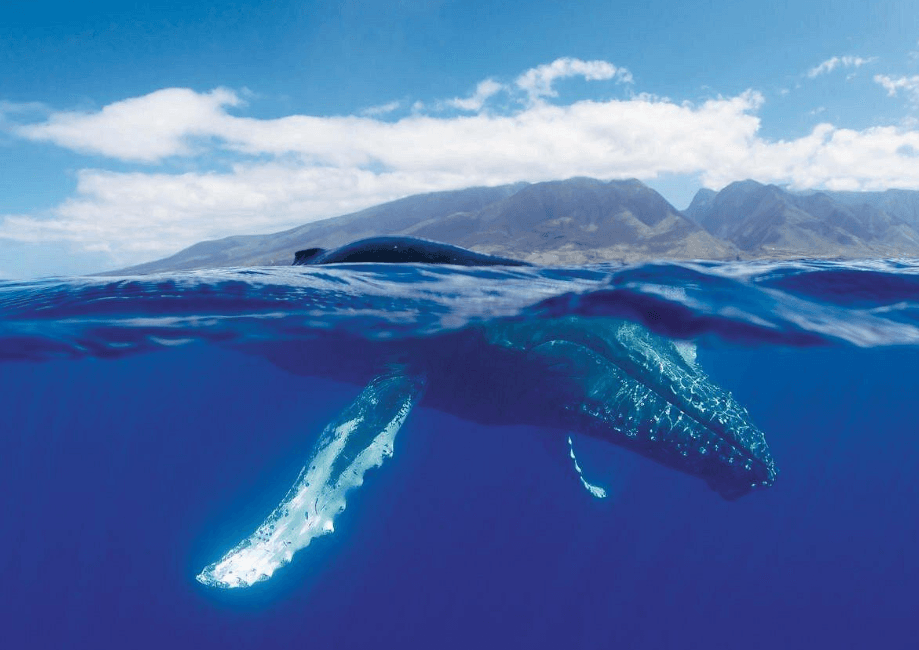
When a humpback whale moves near the surface, only the upper part of its body may be visible above the waterline. Depending on its depth and orientation, the exposed portion can be relatively small.
A whale does not have to raise a large section of its body above the water every time it surfaces. Sometimes, the observer sees only a brief curve of the back.
The amount visible can also change during the same encounter. A slightly different body position may expose more of the back, while another movement leaves only a small section visible.
The important point is that a small visible portion does not tell an observer exactly how much of the whale is underwater or what the animal is doing beneath the surface.
2. Waves Can Hide the Whale’s Back
Ocean waves can obscure a whale even when it is relatively close to the surface.
As a wave rises between the observer and the animal, part of the whale’s back may disappear from view. When the wave passes, a small section may become visible again.
This can create the impression that the whale is repeatedly appearing and disappearing, even if some of the apparent change is caused by the water rather than a major change in the animal’s position.
Wave height and direction matter, as does the position of the boat. Two passengers looking from different sides of a vessel may see different portions of the same whale.
For visitors in Samaná Bay, this is a useful reminder that the sea surface affects not only comfort and visibility but also how wildlife appears during an encounter.
3. The Whale May Be Moving at an Angle Relative to the Boat
The direction in which a whale moves can affect how much of its back is visible.
If the whale moves across the observer’s field of view, its back may be relatively easy to distinguish. If it moves toward or away from the boat, the visible outline may look narrower or shorter.
The whale’s body may therefore appear less exposed than it would from another viewing angle.
Perspective can be particularly misleading when the animal is far away. A large whale at a distance may produce only a small visible shape, making it difficult to judge its orientation or how close it is to the surface.
This is why the visible size of a whale’s back should not be used alone to estimate the animal’s actual size, depth, or distance.
4. Light and Water Reflections Can Reduce Visibility
Sunlight, glare, and reflections can make it harder to distinguish a whale’s back from the surrounding water.
Bright reflections may conceal subtle outlines, especially when the whale is far away or only a small part of its body is exposed. Under different lighting conditions, the same section of the back may appear much clearer.
Cloud cover can also change the contrast between the whale and the sea.
These conditions influence what observers perceive, but they do not necessarily indicate a change in the whale’s behavior. Sometimes, the animal is simply harder to see.
When visibility is poor, it is better to acknowledge uncertainty than to make detailed claims about a movement that was only partly observed.
5. The Whale May Be Changing Its Depth
A humpback whale can change its position vertically as it moves through the water. A whale swimming near the surface may expose part of its back and then become less visible as it moves deeper.
However, observers cannot determine the animal’s exact depth from a brief glimpse of its back alone.
A small visible section may be consistent with several different underwater positions. The whale might be moving gradually away from the surface, maintaining a relatively shallow path, or changing its orientation.
The visible evidence is not sufficient to establish which explanation applies.
For this reason, it is useful to distinguish a whale becoming less visible from a confirmed observation of a particular diving movement.
6. The Whale May Be Moving Through a Brief Surface Sequence
A whale’s appearance at the surface is part of a continuous movement sequence. The back may become visible before more of the animal appears, or the whale may move away from the observer while remaining partly submerged.
If the observer looks only at one moment, the sighting may seem incomplete. Watching the sequence for longer, when conditions permit, can provide a clearer picture of how the whale moves.
Even then, the full underwater movement remains hidden.
A partial glimpse is therefore best treated as one observation within a larger sequence rather than a complete account of the whale’s behavior.
Does Seeing Only the Back Mean the Whale Is Preparing to Dive?
Not necessarily.
A whale may become less visible before submerging, but the appearance of a small section of its back does not reliably predict that a dive is about to happen.
The whale might continue swimming near the surface, change direction, or move out of view because of waves. The observer may simply lose sight of the animal temporarily.
It is important to distinguish a confirmed submergence from a moment when the whale’s body is no longer visible.
For example, if the whale’s back disappears behind a wave, the observer cannot confidently conclude that the animal has dived. It may reappear in approximately the same area once the view clears.
Careful observation helps prevent these different situations from being confused.
Can You Identify a Humpback Whale From a Small Part of Its Back?
A small glimpse of the back may help an experienced observer recognize that a whale is present, but it usually provides limited information for identifying an individual.
Individual humpback whales are often identified through detailed photographs of their tail flukes and other suitable distinguishing features. A brief view of an undifferentiated section of the back may not provide enough information for reliable individual identification.
The shape, angle, lighting, and clarity of the visible section all influence what can be recorded.
If only a small portion of the whale appears, it is more accurate to document a whale sighting than to claim that a particular individual has been identified without sufficient evidence.
How to Observe a Partially Visible Whale in Samaná Bay
When only a small part of a humpback whale is visible, a few practical observation habits can help you make the most of the encounter.
Watch the surrounding water
Look for the location where the whale appeared and notice whether waves or glare could be hiding the rest of its body. This helps you distinguish limited visibility from a clearly observed movement.
Follow the whale’s position
If the whale reappears, note whether it is in roughly the same area or has moved relative to the boat. Avoid assuming that a disappearance proves the animal has dived.
Look for more than one visual clue
A dark curve alone may be difficult to interpret. If other features become visible, such as a larger section of the back or a recognizable surface movement, they can help clarify what you are seeing.
Listen to your guide
Experienced guides can help passengers understand the visible movement and the limitations of the viewing conditions. Their descriptions should still distinguish direct observations from uncertain interpretations.
Give the whale space
Do not encourage the boat operator to chase a partially visible whale just to obtain a clearer view. Follow applicable wildlife-viewing rules and allow the animal to move naturally.
A brief glimpse can be a valuable part of a whale-watching experience even when it does not produce a dramatic photograph.
Photography Tips for Capturing a Small Section of a Whale’s Back
Photographing a partially visible humpback whale can be challenging because the exposed area may be small and may disappear quickly.
Keep the camera ready. A whale may become visible for only a short period. Having your camera prepared can help you record the moment without sudden movements.
Use the surrounding water as context. A wider photograph can show how much of the animal was visible and how waves affected the encounter.
Avoid excessive cropping. Enlarging a tiny section of the back can make an image look more detailed than the original photograph supports. Keep the limitations of the image in mind.
Record the viewing conditions. A short note about glare, waves, distance, and visibility can help explain why the whale was difficult to photograph.
Write an accurate caption. A caption such as “A small section of a humpback whale’s back appears above the water” is preferable to claiming that the animal was preparing to dive without sufficient evidence.
Photography can preserve what was visible, but it cannot reveal details that the camera did not capture.
What Can Researchers Learn From Partial Whale Sightings?
Partial sightings can contribute to wildlife observations, but their usefulness depends on the information that can be recorded reliably.
Observers may document the time, general location, environmental conditions, and visible features of the whale. These details can help establish that an animal was present even when it was not visible for long.
However, partial visibility can limit the conclusions that researchers draw. A brief view of the back may not provide enough information to identify the individual, determine its exact movement, or estimate its depth.
Research methods must account for these limitations rather than treating every sighting as equally informative.
This illustrates a broader principle in wildlife observation: incomplete evidence can still be useful when its limitations are clearly recorded.
Frequently Asked Questions

Local explorer & expert guide in Montana Redonda.