How Do Humpback Whales Use Their Tail Flukes to Move Through the Water?
Humpback whales are enormous marine mammals, yet they can travel through the ocean with powerful, coordinated movements. One of the most important structures responsible for their swimming ability is the tail, especially the two broad lobes known as tail flukes.
When a humpback whale travels through the waters of Samaná Bay in the Dominican Republic, its tail helps propel its body forward. The movement may be difficult to see clearly from a boat, but the mechanics behind it are a fascinating example of how a large animal moves efficiently through water.
So, how do humpback whales use their tail flukes to swim?
Humpback whales generate most of their swimming thrust by moving their tail flukes up and down. Muscles near the rear of the body drive this movement, while the flukes interact with the surrounding water to produce forward force.
Understanding this process helps explain how humpback whales travel, accelerate, and prepare for dives during their seasonal visits to Samaná.
What Are Humpback Whale Tail Flukes?
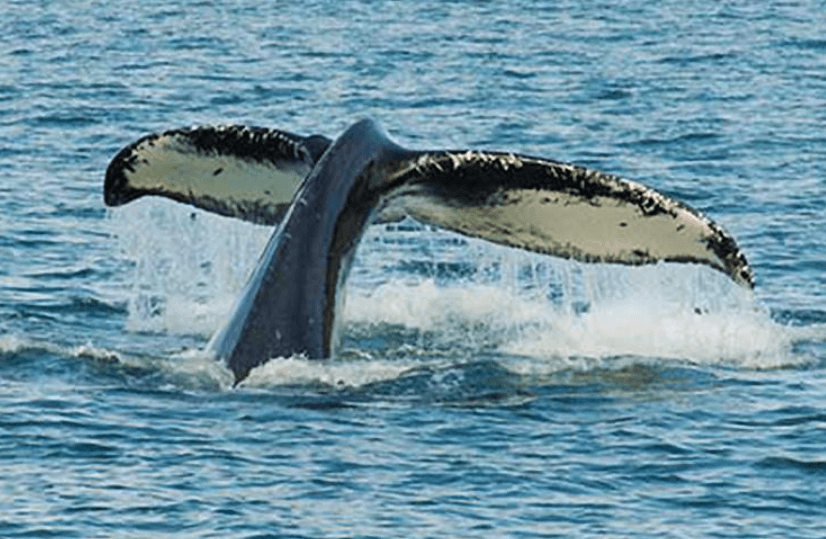
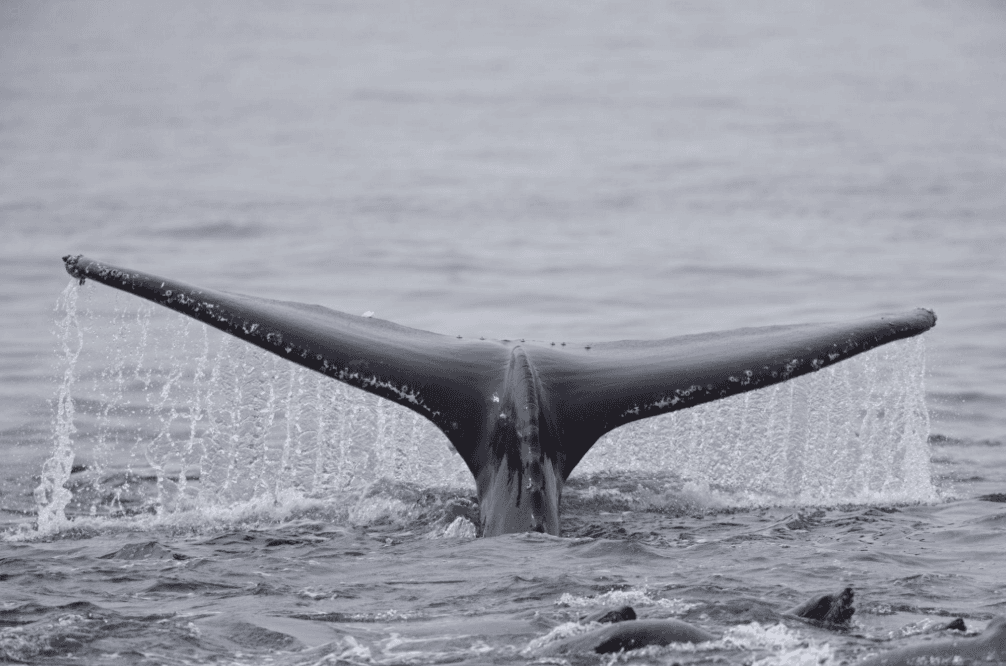
Tail flukes are the two broad, flattened lobes at the end of a whale's tail. They extend horizontally, unlike the vertically oriented tail fins of many fish.
The flukes are connected to a powerful muscular region near the rear of the whale's body. This region transfers movement to the tail, allowing the animal to push against the water.
Why are the flukes shaped this way?
The broad shape gives the tail a substantial surface area to interact with the surrounding water.
As the tail moves, water flows around the flukes and forces develop that contribute to propulsion. The exact forces depend on the speed, angle, and movement of the tail.
The flukes are not rigid paddles. Their structure and flexibility allow them to interact dynamically with water as the whale swims.
How are the two lobes connected to swimming?
The two lobes form one coordinated tail structure. They move together as the tail sweeps up and down.
This coordinated movement helps the whale produce thrust without relying on the side-to-side tail movement typical of many fish.
How Does Up-and-Down Tail Movement Push a Whale Forward?
Humpback whales move their tails vertically through the water. This movement is powered by strong muscles in the rear portion of the body.
When the tail moves, its flukes push against the surrounding water. The resulting hydrodynamic forces help propel the whale forward.
The process is more complex than simply pushing water backward with a flat surface. The flukes change angle during their movement, and water flowing around them contributes to the production of thrust.
The role of the muscles
Powerful muscles in the whale's body generate the motion that travels toward the tail.
The movement involves coordinated bending of the body and motion of the tail region. This allows a large animal to produce repeated strokes while swimming.
The whale can change its swimming effort by changing the strength, frequency, and range of its tail movements.
Why repeated strokes matter
A single tail stroke produces force, but continued swimming usually involves repeated movements.
By cycling its tail up and down, a humpback whale can maintain forward motion through the water. The details of its stroke pattern vary according to its activity and swimming conditions.
The animal does not need to use the same intensity for every movement. Traveling steadily and accelerating require different levels of effort.
How Is a Whale's Tail Different from a Fish's Tail?
One of the most interesting differences between whales and many fish is the orientation of their tails.
Most fish have vertically oriented tail fins and typically move them from side to side. Humpback whales have horizontally oriented tail flukes and move them up and down.
Both arrangements can generate thrust, but they operate through different patterns of body and tail movement.
Horizontal flukes in whales
A humpback whale's tail flukes extend horizontally across the rear of its body.
During swimming, the tail rises and falls, with the surrounding water generating forces that propel the whale.
This movement is characteristic of cetaceans, the group that includes whales, dolphins, and porpoises.
Vertical tails in many fish
Many fish move their tails laterally, pushing water to either side as they swim.
Their body shape, muscles, and tail structures are adapted to that swimming pattern.
The difference between fish and whales reflects distinct evolutionary histories. Whales are mammals whose ancestors returned to aquatic environments, while fish developed swimming systems along different evolutionary paths.
Neither tail orientation is universally better. Each is part of an integrated body design suited to the animal's way of life.
How Does the Tail Help a Humpback Whale Accelerate?
A whale can alter the strength and timing of its tail strokes to change its swimming speed.
When stronger forward movement is needed, more forceful strokes can increase the thrust produced by the tail. Acceleration also depends on factors such as body position, drag, and the whale's existing speed.
Stronger movements produce greater thrust
The tail is powered by substantial muscles, allowing the whale to generate powerful strokes.
However, the relationship between effort and speed is not a simple one-to-one equation. Water resistance increases with swimming speed, and the whale's body and flukes interact with the water in complex ways.
Different movements for different situations
A whale moving steadily does not necessarily need the same tail-stroke intensity as one accelerating or performing a vigorous movement.
Humpback whales can vary their swimming behavior, and the visible strength of a tail stroke can change between activities.
Observers should not assume that every powerful stroke indicates an emergency or that a slow-moving whale is necessarily tired. The meaning of a movement depends on the wider context.
What Happens to the Tail Before a Deep Dive?
One of the most recognizable sights during whale watching is a humpback whale lifting its tail flukes above the surface before descending.
This behavior is commonly called a fluke-up dive.
As the whale prepares to descend, it may change its body angle and raise its tail region. In some dives, the flukes become clearly visible above the water. In others, the whale descends without showing them.
Why raise the tail?
Raising the tail can be part of the body movement associated with a steep descent. The whale adjusts its posture and uses its tail to control its movement underwater.
The visible display depends on the whale's dive angle, movement, and other conditions.
Not every dive requires a conspicuous fluke-up movement. A whale can descend with its tail remaining below the surface.
Does a raised tail predict how long the whale will stay underwater?
The tail display alone cannot reliably tell an observer exactly how long the whale will remain submerged.
Dive duration depends on several factors, including the whale's activity and physiological state. A surface observation does not reveal all of these variables.
For whale watchers in Samaná, a fluke-up dive is an opportunity to observe the whale's anatomy and movement, rather than a precise countdown to its next appearance.
Can Humpback Whales Use Their Tails to Change Direction?
The tail contributes to more than forward movement. By changing how it moves, the whale can influence its motion and orientation.
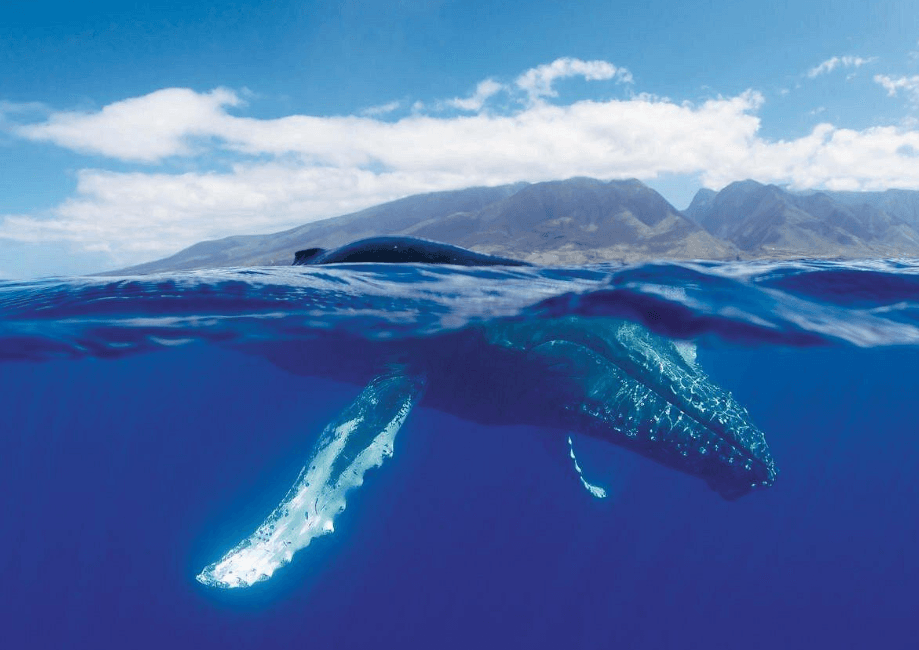
Turning, however, is a coordinated process involving the tail, body, and pectoral fins.
Tail movement and turning
Changes in tail-stroke direction, force, or timing can affect the whale's movement through the water.
These changes may contribute to a turn or adjustment in trajectory. The whale's body position and pectoral fins also influence how the turn develops.
It is therefore misleading to describe the tail as the only steering mechanism.
Why the whole body matters
A humpback whale has a large body moving through a fluid environment. Its movements depend on the interaction of multiple structures.
The tail supplies most of the forward thrust, while the pectoral fins help with maneuverability and control. The body connects these movements into a coordinated swimming system.
This combination allows the whale to travel while also adjusting its direction and posture.
What Can Tail Flukes Tell Us About Humpback Whales?
Tail flukes provide useful clues for both whale watchers and researchers.
Their shape and pigmentation patterns can vary between individuals. Photographs of the underside of the flukes are widely used in humpback whale photo-identification research.
Researchers may compare fluke photographs collected on different occasions to help determine whether sightings involve the same individual.
Individual identification
The underside of a humpback whale's tail can display a distinctive combination of light and dark areas, scars, and other markings.
When images are clear enough, these features can help researchers match individuals across sightings.
Identification work can contribute to long-term studies of movement, population structure, and whale behavior.
Movement observations
The way a whale raises, lowers, or moves its tail can also be recorded as part of a behavioral observation.
Scientists must interpret such observations carefully. A visible tail movement does not automatically reveal the whale's motivation or physiological condition.
Reliable conclusions depend on systematic observations and appropriate research methods.
Observing Tail Flukes During Whale Watching in Samaná
Samaná is a well-known seasonal destination for observing North Atlantic humpback whales. During the breeding season, visitors may see whales surfacing, swimming, diving, or lifting their flukes.
A tail display is not guaranteed on every excursion. Whale behavior is variable, and some dives occur without the flukes becoming visible above the water.
What should visitors look for?
If a whale raises its tail, notice the broad horizontal shape and the pattern on the underside. You may also observe how the body angle changes before the animal descends.
Different sightings can reveal different parts of the swimming process. A whale swimming at the surface may show little of its tail, while a fluke-up dive can provide a clearer view.
Watch responsibly
Follow the tour guide's instructions and applicable wildlife-viewing rules. Avoid encouraging a boat operator to pursue a whale simply to obtain a closer tail photograph.
Respectful viewing gives the animal space to continue its natural behavior and helps keep the encounter safer for people and wildlife.
For travelers interested in marine life, learning about the tail's function can make even a brief sighting more informative.
Frequently Asked Questions
How do humpback whales move their tails?
Humpback whales move their tail flukes up and down. Muscles in the rear of the body power the movement, and the flukes interact with the water to generate thrust.
Do tail flukes propel a humpback whale forward?
Yes. The tail flukes are the main structures responsible for generating forward thrust during swimming.
Why do humpback whales have horizontal tail flukes?
Their horizontal flukes are adapted to an up-and-down swimming motion. This differs from the side-to-side tail movement used by many fish.
Why do humpback whales raise their tails before diving?
A raised-tail display can occur when a whale changes its body angle for a deeper descent. Not every dive includes a visible display of the flukes.
Can humpback whales steer with their tails?
Tail movements can contribute to changes in motion and direction. Steering involves the tail, body, and pectoral fins working together.
Can you identify a humpback whale by its tail?
Researchers can often identify individual humpback whales using photographs of the underside of their flukes, where pigmentation and other markings may form a distinctive pattern.
Will every whale-watching trip in Samaná include a tail-fluke display?
No. Humpback whales do not show their flukes on every dive, and wildlife behavior cannot be guaranteed.
Conclusion
Humpback whale tail flukes are powerful structures that make swimming possible for these enormous marine mammals. Their up-and-down movement generates most of the thrust that carries the whale through the water, while the body and pectoral fins contribute to coordinated movement and control.
The same tail can be seen during a range of activities, from ordinary swimming to a conspicuous fluke-up dive. Its markings can also help researchers identify individual whales over time.
During a Samaná whale-watching trip, understanding the mechanics of the tail offers another way to appreciate the animal beyond its size and surface displays. A raised fluke is not just a memorable photograph; it is a glimpse of the anatomy and movement that allow a humpback whale to navigate its ocean environment.

Local explorer & expert guide in Montana Redonda.